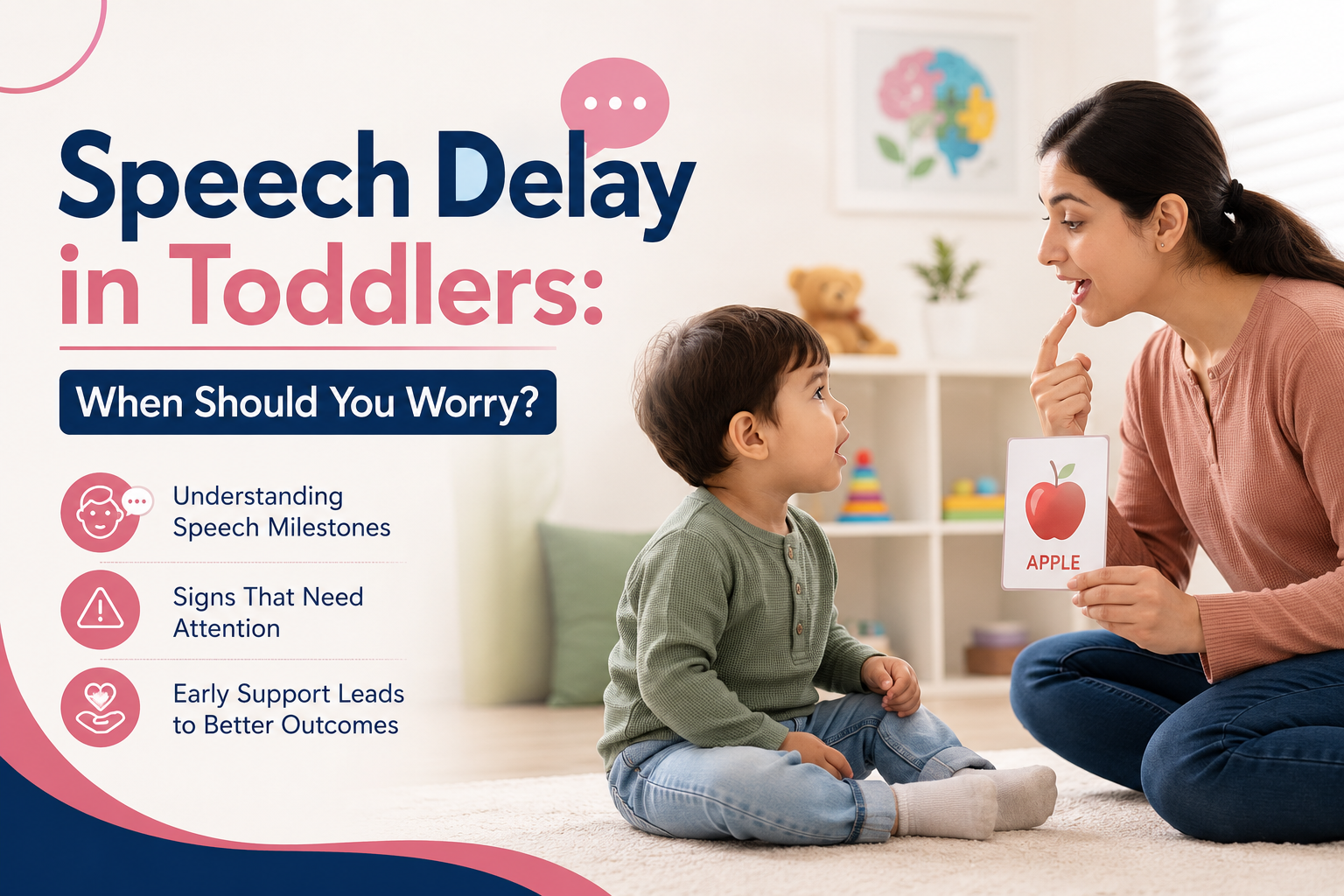
A child’s first words are one of the milestones parents look forward to most — so when they don’t come as expected, it’s natural to feel worried. In my years as a developmental pediatrician, “Doctor, why isn’t my child talking yet?” is one of the most common concerns I hear. The reassuring truth is that children develop speech at their own pace, and many so-called “late talkers” catch up beautifully. But some children do benefit from early support — and knowing the difference is key. In this guide, I’ll walk you through the milestones, the warning signs, the possible causes, and when it’s time to seek help.
Speech vs language: what’s the difference?
These two words are often used interchangeably, but they’re not the same. Speech is the physical act of producing sounds and words — how clearly your child articulates. Language is broader: it’s understanding others (receptive language) and expressing thoughts and needs (expressive language), through words and gestures. A child can have difficulty with one, the other, or both, which is why a proper assessment looks at the whole picture.
Speech and language milestones by age
Use these as gentle guides, remembering every child is different:
- By 6 months: cooing and babbling; responding to sounds and voices
- By 12 months: babbling that sounds like conversation; a first word or two (“mama,” “dada”); using gestures like pointing and waving; responding to their name
- By 18 months: roughly 10–20 words; following simple instructions
- By 2 years: around 50 words and beginning to join two words together (“more milk”); about half their speech understandable to familiar people
- By 3 years: short sentences; about three-quarters of their speech understandable to others
Signs of a speech delay
I’d encourage you to consult a professional if your child shows any of these:
- No babbling by 12 months
- No gestures (pointing, waving) by 12 months
- No single words by 16 months
- No two-word phrases by 24 months
- Loss of speech or language skills at any age
- Not responding to sounds or their name
- Difficulty understanding simple directions
Late talker or speech delay?
This is an important distinction. A “late talker” is usually a toddler (around 18–30 months) who understands language well and is developing normally in play, motor, and social skills, but is simply slower to start speaking. Many late talkers catch up. A speech-language delay is broader — it may affect understanding as well as speaking, or occur alongside other developmental areas, and it’s more likely to benefit from support. Only an assessment can tell which is which.
What causes speech delay?
There are many possible reasons, and most are very manageable. Common causes include hearing difficulties (often from frequent ear infections), autism spectrum disorder, oral-motor difficulties affecting the muscles used for speech, broader developmental conditions, and sometimes limited language stimulation in a child’s environment. And often, there’s no identifiable cause at all — the child is simply a late bloomer.
I also want to bust a common myth I hear from families across Mumbai: being raised in a bilingual or multilingual home does not cause speech delay or disorder. Multilingual children may briefly mix languages, but this is completely normal and not a problem.
Could it be a hearing problem?
This is the first thing I always check — because a child learns to speak by hearing speech. Even mild or intermittent hearing loss, often from repeated ear infections, can significantly delay language. At my clinic, we offer painless, child-friendly hearing tests such as BERA (Brainstem Evoked Response Audiometry), OAE, and Pure Tone Audiometry, which help us rule out or identify hearing issues early. If your toddler isn’t talking, ruling out a hearing problem is an essential first step.
The role of screen time
I’d be remiss not to mention this. Excessive screen time — especially in the early years — is increasingly linked to speech and language delays, because it replaces the back-and-forth interaction that builds language. My gentle advice: minimise screens for young toddlers, and instead talk, read, and play with your child as much as you can. Real conversation is the best “language app” there is.
When should you see a specialist?
Please don’t rely on “wait and see” if your child is showing the warning signs above. Consulting a developmental pediatrician or speech therapist early allows us to understand what’s happening and, if needed, begin support during the years when it works best. Early help is always easier and more effective.
How speech delay is treated
Treatment depends entirely on the cause. After an assessment — including a hearing check — we may recommend speech and language therapy, which is playful, engaging, and tailored to your child. Where there’s an underlying cause, we address that too. The encouraging news is that most children make wonderful progress with the right, timely support.
How you can help at home
You are your child’s best language teacher. Talk to them throughout the day, narrate what you’re doing, read picture books together, sing songs, name objects, and — crucially — respond warmly to every attempt they make to communicate, whether it’s a sound, a gesture, or a word.
Expert support at Dr. Priti Mhatre’s Clinic
If your toddler isn’t talking as expected, I’m here to help you understand why and to guide you with warmth and clarity. With over 15 years of experience and in-house hearing and developmental assessments, I support families across Navi Mumbai and Thane with personalised, evidence-based care.
📞 Book a consultation: +91 73048 26455 · Dr. Priti Mhatre — Developmental Pediatrician, Navi Mumbai & Thane
Frequently Asked Questions
- When should my child start talking?
Most children say a first word or two by 12 months, around 10–20 words by 18 months, and begin joining two words by age two. These are guides, as every child is different. - When should I worry about a speech delay?
Consult a specialist if there’s no babbling or gestures by 12 months, no words by 16 months, no two-word phrases by 24 months, or any loss of skills. - Is my child just a late talker?
Possibly. Late talkers understand well and develop normally otherwise, but are slower to speak. An assessment can tell whether it’s a simple delay or needs support. - Does bilingualism cause speech delay?
No. Growing up with two or more languages does not cause speech delay or disorder. Multilingual children may briefly mix languages, which is normal. - Can hearing problems cause speech delay?
Yes, very commonly. Even mild hearing loss from ear infections can delay speech, which is why a hearing test is an important first step. - Does screen time affect speech development?
Excessive screen time in early childhood is linked to speech delays because it reduces real interaction. Talking, reading, and playing support language far better. - Can speech delay be treated?
Yes. Most children improve well with speech therapy and early support, especially when the cause — such as a hearing issue — is identified and addressed early.