Phone No: 073048 26455
Email Address:info@drpritimhatre.com

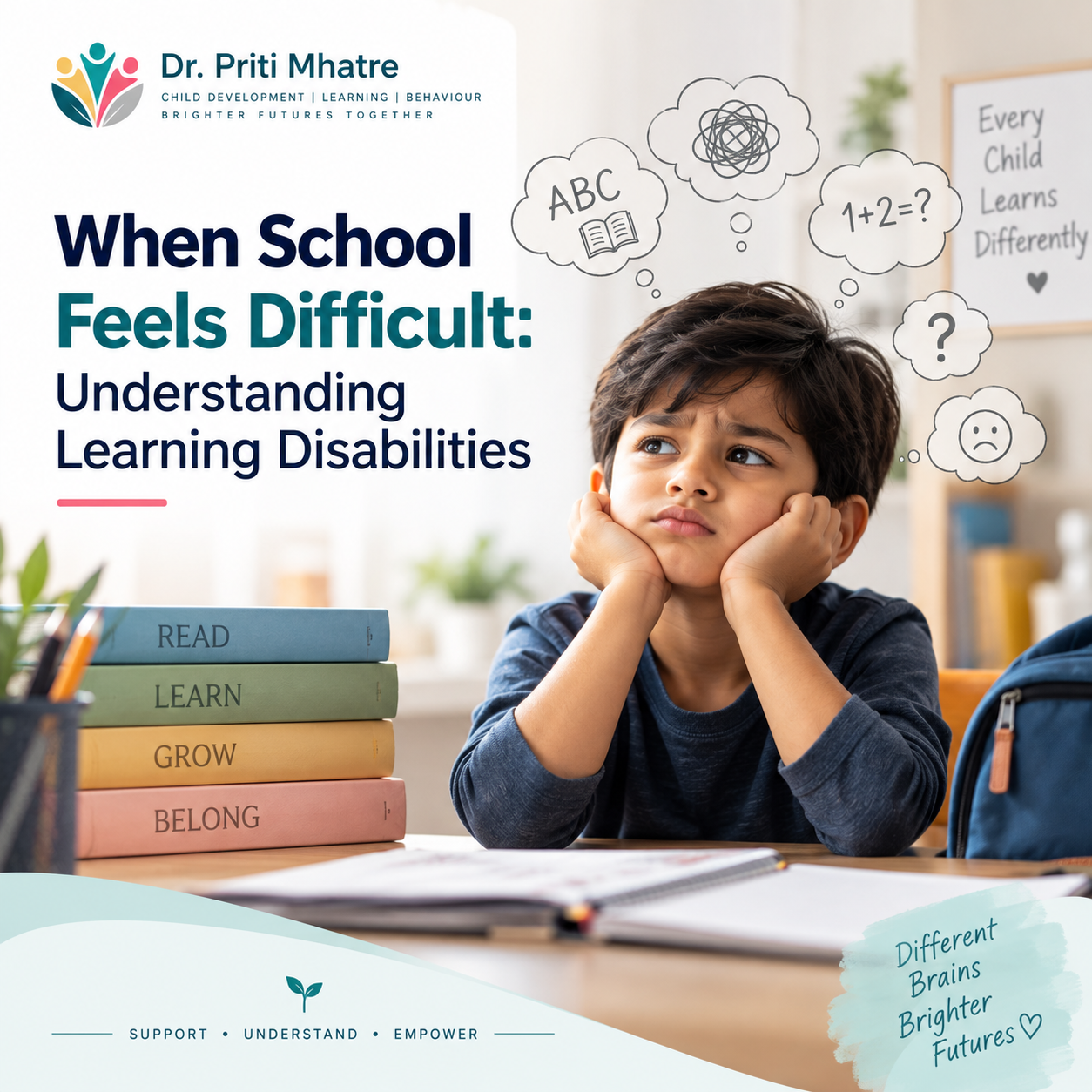
When a Child Isn’t Lazy: How School Refusal Revealed a Learning Disability
- September 21, 2026
- Uncategorized
- teamoceanpune@gmail.com
- 0 Comments
Dr. Priti Mhatre's Clinic
Specialized Care for Your Child's Development
15+ years of expertise diagnosing and treating Autism, ADHD, Speech & Learning Delays and Behavioral concerns — with personalized, family-centered treatment plans for over 5,000 children across Navi Mumbai & Thane.
Introduction
When a child suddenly refuses to go to school, becomes irritable, or reacts to homework with distress, it’s natural for parents to look for an emotional trigger — a fight with a friend, a family change, a difficult phase. But sometimes the real story is hiding underneath the behaviour, not beside it.
This case follows a 12-year-old boy whose school refusal and threats of self-harm were first read as an emotional reaction to a friend moving away. What was actually happening was years of unrecognized academic struggle, family criticism, and a Specific Learning Disability (SLD) that no one had thought to look for.
The Presenting Problem
A 12-year-old boy was brought to the clinic by his mother, who was visibly distressed. He had become restless and irritable, was refusing to attend school, and would become extremely distressed — even threatening self-harm — whenever academic demands were placed on him.
His mother’s initial explanation was simple:
“He is very upset because his friend has left. Please counsel him.”
Digging Deeper
A fuller history told a different story. He was cheerful, socially well-adjusted, and good at sports — but academics had always been a struggle. His father was strict about studies and frequently punished him for poor performance. Visiting grandparents added to the pressure, repeatedly telling him he wasn’t trying hard enough.
Over time, this had eroded his self-esteem. Notably, his anxiety and behavioural difficulties consistently showed up around schoolwork, academic expectations, and visits from critical family members — a pattern his mother had noticed but interpreted as a personality issue rather than a warning sign.
Assessment: Looking Beyond Behaviour
A child’s behaviour often tells us that something isn’t working for them — it shouldn’t be assessed in isolation. A detailed developmental assessment revealed academic difficulties that were disproportionate to his overall abilities, prompting a referral for a comprehensive psychoeducational assessment.
The assessment confirmed a Specific Learning Disability (SLD).
The Diagnosis: Specific Learning Disability
The diagnosis filled in the missing piece. He wasn’t lazy, careless, unserious, or lacking effort — he had a genuine neurodevelopmental difficulty affecting his academic learning. For years, that difficulty had been read as a problem of attitude rather than one requiring proper assessment and support.
The Intervention
- Psychoeducation for the Family
The first step was helping the child and his family understand what a learning disability is — and what it isn’t. His father and grandparents were counselled on:
- His actual learning profile
- The difference between intelligence and specific academic skills
- Why increased pressure doesn’t correct a learning disability
- How repeated criticism affects self-esteem
- The importance of positive reinforcement and realistic expectations
- Structured Remediation
Remediation was targeted to his specific learning profile, not generic tutoring.
For Reading
Phonological awareness, systematic phonics and decoding, fluency-building, and vocabulary and comprehension strategies.
For Writing
Spelling intervention, handwriting and written-output support, sentence construction, and help organising written ideas.
For Mathematics
Strengthening number concepts, explicit teaching of procedures, visual and concrete representations, and step-by-step problem-solving strategies.
- School Support and Accommodations
The school was encouraged to provide appropriate support, and the family was guided on the examination provisions available to eligible students with SLD. The central shift was in framing: from “why isn’t he trying harder?” to “what is he finding difficult, and how can we help him learn?”
What Is a Specific Learning Disability?
Specific Learning Disability is a neurodevelopmental condition in which a child has persistent, significant difficulty acquiring particular academic skills despite appropriate learning opportunities.
Areas It Can Affect
Reading
Difficulty with accurate or fluent reading and decoding.
Written Expression
Difficulty with spelling, writing, or organising written language.
Mathematics
Difficulty with number concepts, calculation, or mathematical reasoning.
An important distinction
Learning disability is not the same as low intelligence. A child with SLD may have average or above-average intellectual ability — the difficulty is specific, not a reflection of overall intelligence.
Educational Accommodations Under the RPwD Act, 2016
Under the Rights of Persons with Disabilities (RPwD) Act, 2016, Specific Learning Disability is recognised as a specified disability. Eligible students may receive reasonable accommodations and examination support, subject to the rules and certification requirements of their education board.
Possible Accommodations
- Additional or compensatory time
- Scribe, reader, or writer support where indicated
- Use of assistive technology
- Computer-related support where permitted
- Rest breaks in applicable circumstances
- Appropriate concessions relating to spelling/writing in specified situations
- Other examination accommodations prescribed by the respective board
Steps to Access Accommodations
A diagnosis should be followed by a clear process:
Recommended sequence
Appropriate assessment → required certification/documentation → application through the prescribed process → communication with the school/board well before examinations.
Board-specific note
Exact provisions differ across SSC, CBSE, CISCE, and NIOS. Parents should verify current regulations with their child’s specific board, guided by RPwD and DEPwD frameworks.
What This Case Teaches Us
- Behaviour Is Often Communication
School refusal, anger, avoidance, and emotional outbursts can be the visible expression of an underlying academic or developmental difficulty.
- Don’t Label a Child Before Understanding the Difficulty
“Lazy,” “careless,” “not serious,” and “doesn’t put in effort” can become deeply damaging labels.
- Intelligence Does Not Rule Out Learning Disability
A child can be intelligent, socially capable, creative, and excellent at sports — and still have a significant learning disability.
- Look for Patterns
If behavioural difficulties consistently occur around reading, writing, mathematics, homework, or school, it’s worth asking why.
- Early Identification Matters
Unaddressed academic struggle can spiral: failure → criticism → low self-esteem → avoidance → conflict → emotional distress. Early identification can interrupt this cycle.
Conclusion
A child who repeatedly struggles academically is not necessarily unwilling to learn — sometimes he is trying very hard and still struggling. Before calling a child lazy, careless, or unserious, it’s worth asking whether a learning difficulty lies underneath the behaviour.
Identifying that difficulty, providing the right remediation, modifying expectations, and offering appropriate support doesn’t just improve academics — it protects a child’s confidence, self-esteem, and relationship with learning itself.
Frequently Asked Questions (FAQs)
- Can school refusal or threats of self-harm really be linked to a learning disability?
Yes. When a child cannot keep up academically despite genuine effort, and faces repeated criticism or pressure, the resulting distress can show up as anxiety, anger, avoidance, or even threats of self-harm around academic situations.
- How is a Specific Learning Disability different from low intelligence or laziness?
SLD is a specific difficulty in acquiring certain academic skills — reading, writing, or maths — despite average or above-average intelligence and adequate learning opportunities. It reflects a neurodevelopmental difference, not a lack of ability or effort.
- How is Specific Learning Disability diagnosed?
Diagnosis typically follows a developmental assessment and a comprehensive psychoeducational evaluation that looks at academic skills relative to overall cognitive ability, rather than relying on grades or classroom behaviour alone.
- Does punishing or pressuring a child with a learning disability help improve their performance?
No. Increased pressure or punishment does not correct a learning disability and can worsen self-esteem, anxiety, and avoidance behaviours. Structured remediation and realistic expectations are far more effective.
- What does remediation for a learning disability actually involve?
Remediation is targeted, not generic tutoring. Depending on the area affected, it may include phonics and reading-fluency work, spelling and written-expression support, or step-by-step strategies for number concepts and mathematical reasoning — delivered in a structured, individualised, and monitored way.
- What accommodations are available for students with SLD in India?
Under the RPwD Act, 2016, eligible students may access accommodations such as extra time, scribe or reader support, assistive technology, and specific concessions during examinations. Exact provisions vary by education board (SSC, CBSE, CISCE, NIOS), so parents should check current board-specific regulations.
- What should a parent do if they suspect their child has a learning disability?
Rather than assuming the issue is motivation or attitude, parents should seek a developmental assessment and, if indicated, a comprehensive psychoeducational evaluation — then follow through with certification, school communication, and appropriate remediation and accommodations.
