Phone No: 073048 26455
Email Address:info@drpritimhatre.com

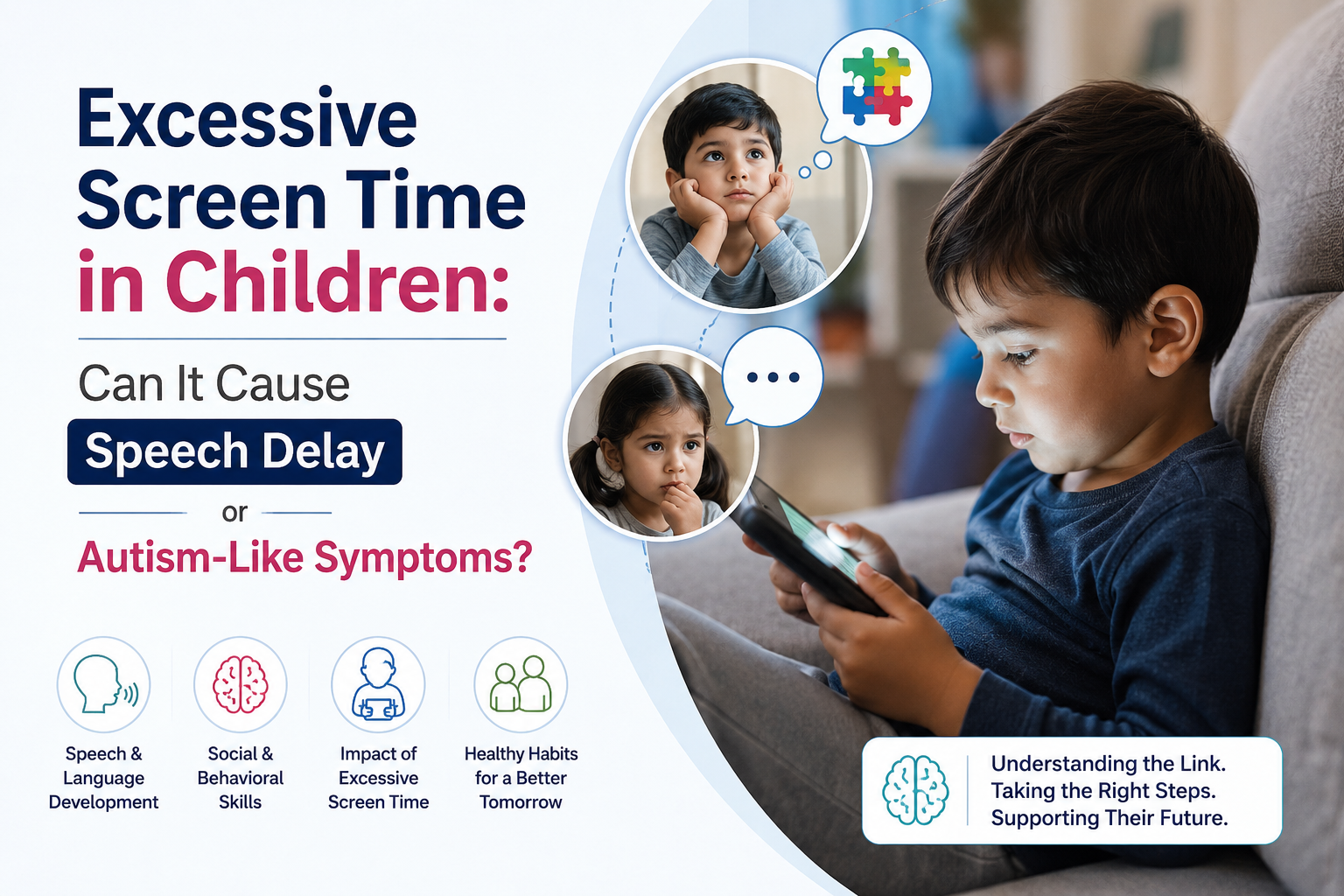
Excessive Screen Time in Children: Can It Cause Speech Delay or Autism-Like Symptoms?
- August 26, 2026
- Uncategorized
- teamoceanpune@gmail.com
- 0 Comments
Dr. Priti Mhatre's Clinic
Specialized Care for Your Child's Development
15+ years of expertise diagnosing and treating Autism, ADHD, Speech & Learning Delays and Behavioral concerns — with personalized, family-centered treatment plans for over 5,000 children across Navi Mumbai & Thane.
In today’s digital world, screens are everywhere — televisions, tablets, smartphones, and laptops have become a part of daily life, even for toddlers. While technology has its benefits, many parents and pediatricians are increasingly concerned about the connection between screen time and speech delay in young children. Some parents also worry whether too much screen exposure can lead to autism-like symptoms. Let’s explore what the evidence suggests, what signs to watch for, and how parents can strike a healthier balance.
Understanding the Link Between Screen Time and Speech Delay
Language development in early childhood depends heavily on real, back-and-forth human interaction. Babies and toddlers learn to speak by watching faces, listening to tone and rhythm, and responding to caregivers in real time. When screens replace this interaction, children may miss out on crucial opportunities to practice communication.
Several pediatric studies have observed a growing pattern linking screen time and speech delay in children under the age of three. Toddlers who spend several hours a day in front of screens — especially without an adult engaging alongside them — often show slower vocabulary growth, delayed sentence formation, and reduced verbal expression compared to peers with limited screen exposure.
This doesn’t mean every child who watches a show will develop a speech delay. But excessive, unsupervised screen time for kids, particularly during the critical early language-development window (roughly 0–3 years), appears to be a contributing risk factor worth taking seriously.
Why Does This Happen?
There are a few reasons experts believe screen time and speech delay may be connected:
- Reduced parent-child interaction: Time spent on screens often replaces conversations, storytelling, and playtime with caregivers.
- Passive consumption: Most children’s content is one-directional. The child watches and listens but isn’t required to respond, unlike a real conversation.
- Overstimulation: Fast-paced visuals and sounds can overstimulate a developing brain, making it harder for children to focus on and process spoken language.
- Reduced physical and social play: Speech development is closely tied to social play, gestures, and shared attention — all of which decrease with heavy screen use.
Can Screen Time Cause Autism-Like Symptoms?
This is an important question, and one that needs a careful answer. Excessive screen time does not cause autism. Autism spectrum disorder (ASD) is a neurodevelopmental condition with genetic and neurological roots, not something caused by external environmental exposure like screens.
However, some children who spend excessive hours on screens may display behaviors that resemble autism-like symptoms, such as:
- Delayed or limited speech
- Reduced eye contact
- Difficulty engaging in social interactions
- Repetitive behaviors or fixation on specific screen content
- Limited response to their name being called
These symptoms can overlap with early autism signs, which is why professional evaluation is important to understand the underlying cause. In some children, reducing excessive screen exposure and increasing interactive play may improve communication and social engagement, while autism requires specialized assessment and support.
Recommended Screen Time for Kids
Health organizations recommend clear limits on screen time for kids, especially in early childhood:
- Under 18 months: Avoid screen time altogether, except for video calls with family.
- 18–24 months: If introduced, screens should involve high-quality content watched together with a caregiver.
- 2–5 years: Limit to no more than one hour a day of screen time for kids, ideally co-viewed and discussed with an adult.
- 6 years and older: Encourage a healthy balance between screen use, physical activity, outdoor play, and face-to-face social interaction.
Signs Parents Should Watch For
If your child is exposed to considerable screen time, keep an eye out for:
- Not babbling or using words by the expected age milestones
- Limited eye contact during conversations
- Trouble following simple instructions
- Preferring screens over playing with people
- Regression in previously learned words or skills
If you notice several of these signs together, it’s worth consulting a pediatrician or speech-language specialist. Early intervention can make a significant difference in a child’s developmental trajectory, regardless of the underlying cause.
How Parents Can Reduce the Risk
- Set consistent daily screen time limits for kids and stick to them.
- Prioritize interactive, unstructured play over passive screen consumption.
- Read aloud, sing, and talk to your child throughout the day.
- Use mealtimes and outdoor time as screen-free zones.
- Choose educational content and watch it together rather than letting children view alone.
Conclusion
While screens aren’t inherently harmful in moderation, the connection between screen time and speech delay is becoming difficult to ignore. Children need real interaction, conversation, and play to build strong language and social skills. If you’re concerned about your child’s speech development or behavior, don’t wait — early evaluation and support can help your child thrive.
For personalized guidance on child development, speech delay, Autism Spectrum Disorder consult with Dr. Priti Mhatre, Developmental Pediatrician, who can assess your child’s specific needs and provide expert evaluation and guidance. Dr. Priti Mhatre is a Developmental Pediatrician specializing in child development, speech delay assessment, autism evaluation, and early intervention guidance for children.
Frequently Asked Questions About Screen Time and Speech Delay
- Does too much screen time cause speech delay in toddlers? Excessive screen time doesn’t directly cause speech delay in every child, but it can be a contributing risk factor. Toddlers learn language through real interaction, and heavy screen use often replaces the conversations and responsive engagement needed for speech development.
- Can screen time make autism symptoms worse? Screen time doesn’t cause or worsen autism itself, since autism is a neurodevelopmental condition. However, in children who are not on the spectrum, excessive screen exposure can produce autism-like behaviors such as reduced eye contact and delayed speech, which usually improve once screen time is reduced.
- How much screen time is safe for a 2-year-old? Most pediatric guidelines recommend no more than one hour a day for children aged 2–5, ideally watched together with a caregiver rather than alone.
- What are the early signs of speech delay in children? Common signs include limited babbling by 12 months, few or no words by 18 months, difficulty combining words by age 2, and trouble following simple instructions.
- Can reducing screen time reverse speech delay? In many cases, yes — especially when the delay is linked to reduced interaction rather than an underlying developmental condition. Replacing screen time with talking, reading, and interactive play often leads to noticeable improvement.
- Is screen time bad for all children? Not inherently. Moderate, supervised, high-quality screen content isn’t necessarily harmful for older children. The concern is mainly around excessive or unsupervised use, especially in children under 2.
- At what age should children start using screens? Experts generally recommend avoiding screens before 18 months, except for video calls with family, and introducing limited, co-viewed content gradually after that.
- Should I consult a doctor if my child shows speech delay? Yes. If your child isn’t meeting speech milestones, it’s best to consult a pediatrician or speech-language specialist early, as timely intervention improves outcomes significantly.
- Can screen time affect a child’s social skills? Yes. Excessive screen use can reduce opportunities for face-to-face interaction, shared play, and social learning, which are all important for developing social and communication skills.
- What can parents do instead of giving screens to toddlers? Parents can engage in reading, singing, storytelling, outdoor play, and simple conversation throughout the day — all of which support language and social development far more effectively than screen time.
