Phone No: 073048 26455
Email Address:info@drpritimhatre.com

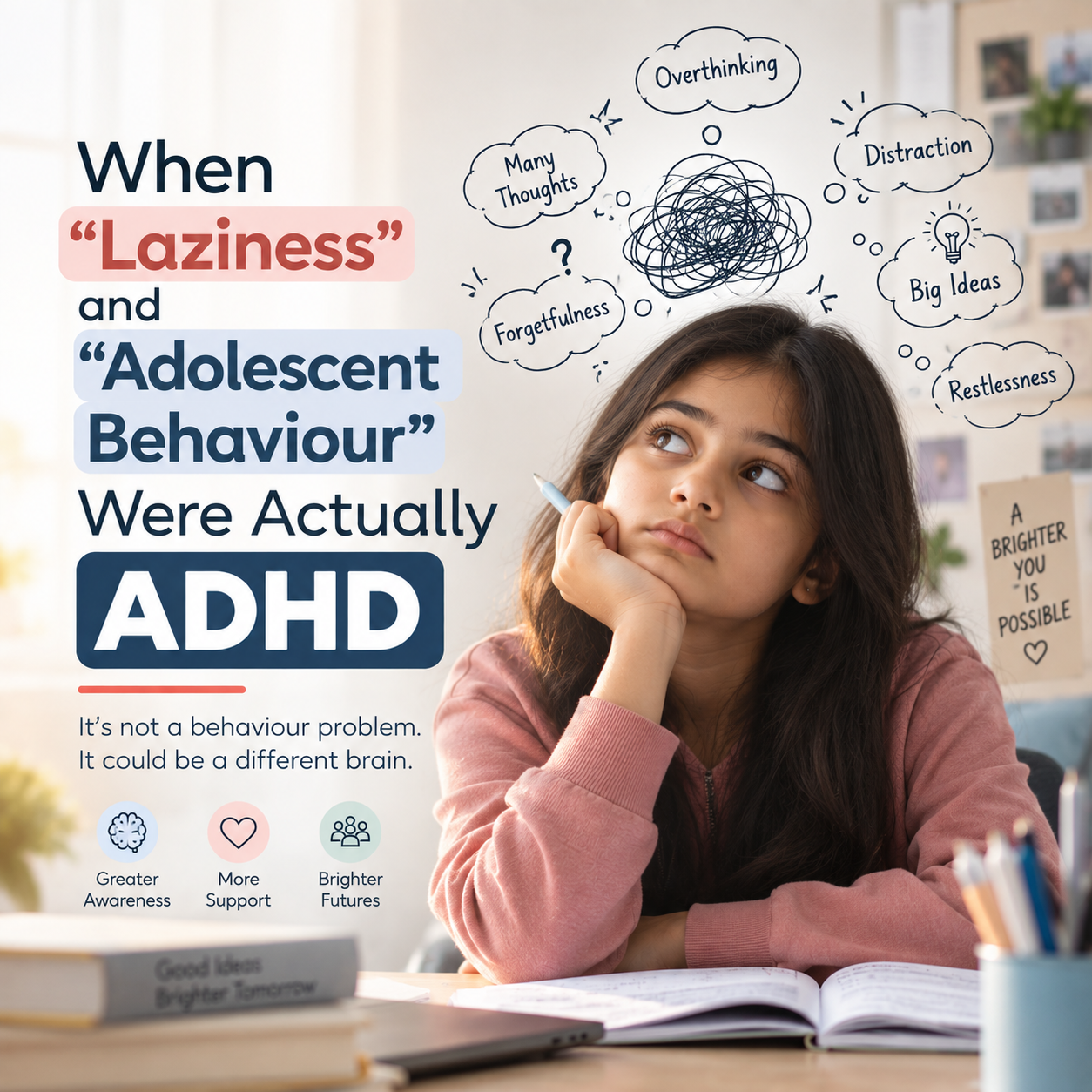
When “Laziness” and “Adolescent Behaviour” Were Actually ADHD
- September 17, 2026
- Uncategorized
- teamoceanpune@gmail.com
- 0 Comments
Dr. Priti Mhatre's Clinic
Specialized Care for Your Child's Development
15+ years of expertise diagnosing and treating Autism, ADHD, Speech & Learning Delays and Behavioral concerns — with personalized, family-centered treatment plans for over 5,000 children across Navi Mumbai & Thane.
Adolescence brings rapid change — academically, socially, and developmentally. Teenagers are suddenly expected to work independently, juggle deadlines, organise their own time, and regulate their emotions without the constant scaffolding of childhood.
For some teens, especially those with ADHD that went unnoticed in earlier years, this jump in expectations exposes struggles that were once well hidden. This case study follows one such story: a bright teenage girl whose inattentive ADHD was mistaken for laziness, low motivation, and “just being a teenager” — until a teacher’s observation and her own self-awareness led to a proper diagnosis.
Initial Perception: “She’s Smart, She’s Just Not Trying
A teenage girl was brought to a developmental paediatric clinic by her father, worried about her attention, organisation, and everyday functioning. She was clearly capable, and her parents always believed she had strong academic potential. But over time, they noticed her struggling more and more with schoolwork and daily responsibilities — and they read it as a motivation problem:
Like many parents in this situation, they assumed adolescence itself was to blame — that with more discipline, she’d snap out of it.
What She Was Actually Experiencing
When she was finally asked to describe her own struggles, a very different picture emerged.
Academic Difficulties
- Starting tasks, even ones she understood clearly
- Organising her schoolwork
- Planning ahead and prioritising
- Remembering instructions and responsibilities
- Finishing assignments
- Staying focused on routine or “boring” tasks
- Breaking big tasks into smaller steps
Everyday Life Difficulties
These weren’t just study problems — they showed up in her daily routines too, from managing time to organising herself independently. There was a real gap between how capable she was and how consistently she could turn that capability into action.
The Teacher Who Noticed Something Different
A turning point came from an unexpected place: her classroom teacher, who noticed her struggling to stay focused and keep up with classroom demands, and raised the possibility of ADHD.
That single observation reframed the whole situation. It was no longer just “she isn’t working hard enough” — there might be something neurodevelopmental underneath it.
When a Teenager Turns to ChatGPT for Answers
Curious about her own struggles, the girl began researching ADHD online and explored her symptoms using ChatGPT. As she read about inattentive ADHD and executive dysfunction, she recognised herself in the descriptions and started to wonder if this explained what she’d been going through.
She brought this to her father — and here’s the important part: the family didn’t stop at an AI-generated explanation. Her father took her for a proper developmental assessment. Her self-awareness didn’t provide a diagnosis, but it started the process that led to one.
The Comprehensive Developmental Assessment
A detailed developmental and clinical evaluation followed, looking at her developmental history, academic functioning, attention, executive functioning, classroom behaviour, and everyday life across multiple settings.
The overall picture pointed clearly to ADHD, predominantly inattentive presentation — a diagnosis based on the full clinical picture, not on symptoms she’d matched to an online description.
Why Was Her ADHD Missed for So Long?
A few reasons stood out:
- She was intelligent, with genuine academic potential
- She didn’t fit the “stereotypical” ADHD picture — no hyperactivity, no disruptive behaviour
- She had developed compensatory strategies that worked for a while
During childhood, parents and teachers quietly provide a lot of structure: reminders, supervision, help with organisation, predictable routines. As she moved into adolescence, that external support faded just as the demands on her multiplied. The ADHD didn’t appear in adolescence — it had been there all along, just masked by support that eventually wasn’t enough.
Understanding ADHD in Girls
This case is a good example of a broader pattern: ADHD in girls often doesn’t look like the stereotype. Girls with predominantly inattentive symptoms are more often described as:
- Dreamy
- Forgetful
- Disorganised
- Careless
- Slow
- Easily distracted
- Inconsistent
- Unmotivated
- “Not living up to their potential”
They’re rarely disruptive. They may sit quietly while struggling internally, and they often compensate well enough — through intelligence, memory, or parental support — that nobody notices anything is wrong. It’s usually adolescence, with its demand for independence, that finally exposes the gap.
The Intervention: A Multimodal Approach
Once diagnosed, treatment went beyond grades — the goal was to help her understand her own profile and build real independence.
- Understanding the Condition
Psychoeducation helped the family separate two very different things:
“I don’t want to do it” versus “I want to do it, but I’m struggling with the executive functions to get it done.”
This alone shifted the family narrative away from blame.
- Building Executive-Function Skills
Task Initiation
Large, vague tasks were converted into a clear first step.
Example
Old approach
“Study Science.”
New approach
“Open the textbook → find the chapter → read two pages → highlight key points.”
Task Breakdown
Big assignments were split into smaller, less overwhelming pieces, making it easier to start and track progress.
Time Management
Visual schedules, timers, time blocks, and realistic daily targets made time visible instead of abstract.
Externalising Memory
Checklists, planners, reminders, and calendars did the remembering so her brain didn’t have to.
Prioritisation
She learned to sort tasks by urgent vs. important, and must-do vs. nice-to-do, reducing the feeling of being overwhelmed.
- Study Skills
Shorter focused study blocks, active recall, spaced revision, retrieval practice, written summaries, and studying in a low-distraction environment replaced vague, motivation-dependent studying.
- Home Strategies
Parents shifted from “go and study” to scaffolding questions: What’s the first thing you need to do? What are today’s three tasks? How much time will this take? The aim was to gradually hand responsibility back to her.
- Medication
Medication was one part of a broader plan — never a substitute for building skills.
The Outcome: Follow-Up Progress
At follow-up, she was initiating tasks, organising her work, planning ahead, and completing responsibilities far more consistently — and using her strategies independently.
Just as importantly, her self-understanding changed. The conversation shifted from “why don’t you try harder?” to “what strategy will help you do this?” — a shift that mattered as much for her parents as it did for her.
Key Lessons From This Case
- Adolescence Can Unmask ADHD
Rising demands can reveal difficulties that were always there but well compensated for.
- Intelligence Doesn’t Protect Against ADHD
Academic potential and executive functioning are not the same skill.
- “Lack of Motivation” Needs Closer Examination
When intention repeatedly fails to become action, consider executive functioning, learning differences, emotional regulation, sleep, or mental health — not just effort.
- Girls With ADHD Are Often Missed
A quiet, capable, non-disruptive girl can still have significant ADHD.
- Listen to Adolescents
A teen’s self-diagnosis shouldn’t be accepted automatically — but it shouldn’t be dismissed either. It’s worth investigating.
- Treatment Should Be Holistic
Medication helps, but skills, routines, and psychoeducation matter just as much.
Conclusion
This case is a reminder of how easily inattentive ADHD in a bright teenage girl can be mistaken for laziness or “just being a teenager.” She had the intelligence to know what was expected of her — what she lacked was the executive-function support to consistently act on it.
Her teacher noticed. She went looking for answers herself. Her father listened and sought professional help. And a proper assessment uncovered what years of “try harder” never could.
Sometimes a struggling teenager isn’t lazy — she’s telling us, in the only language she has, that a developmental skill needs support. And sometimes, she knows that before the adults around her do.
Frequently Asked Questions (FAQs)
- Can ADHD really be hidden until the teenage years?
Yes. Children with strong compensatory strategies, high intelligence, or heavy support from parents and teachers can appear to manage well in childhood. As independence and workload increase in adolescence, these hidden difficulties often become visible for the first time.
- Why is ADHD in girls often missed or diagnosed later than in boys?
Girls are more likely to have the inattentive presentation, which lacks the hyperactive or disruptive behaviour typically associated with ADHD. They may appear dreamy, quiet, or simply “unmotivated” rather than obviously struggling, so the condition is often overlooked.
- Is it a problem for a teenager to research their symptoms using ChatGPT or the internet?
Self-research isn’t the problem — treating it as a diagnosis would be. In this case, the teenager’s research prompted a conversation with her father, who then sought a proper professional assessment. Online information can be a useful starting point for self-awareness, but it should always lead to a qualified evaluation, not replace one.
- How is inattentive ADHD diagnosed in adolescents?
Diagnosis involves a comprehensive developmental and clinical assessment covering developmental history, academic functioning, attention, executive functioning, classroom behaviour, and everyday functioning — not a single symptom checklist or online quiz.
- What is executive dysfunction, and how is it different from laziness?
Executive dysfunction refers to difficulty with the mental processes needed to plan, initiate, organise, and complete tasks — even when someone genuinely wants to do them. Laziness implies a lack of will; executive dysfunction is a lack of ability to translate will into action.
- Is medication necessary to treat ADHD in teenagers?
Medication can be a valuable part of treatment, but it works best as one component of a broader plan that includes executive-function coaching, study skills training, home strategies, and psychoeducation — not as a stand-alone solution.
- What can parents do at home if they suspect their teenager has ADHD?
Instead of repeating instructions like “go and study,” parents can help by asking guiding questions — such as what the first step is, what today’s priorities are, and how much time a task might take — to scaffold planning skills rather than take over completely.
