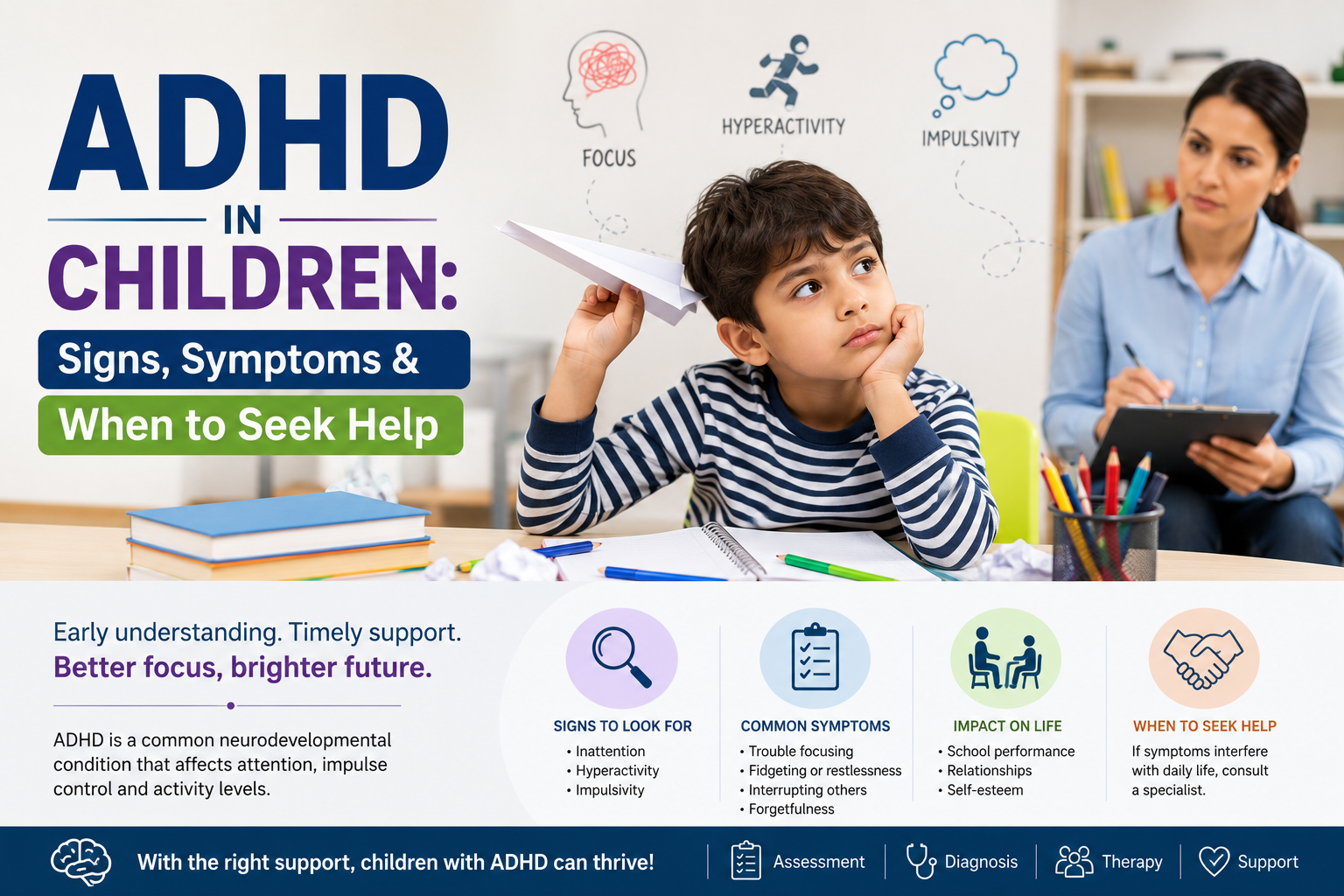
One of the things that saddens me most in my practice is how often children with ADHD are misunderstood — labelled “naughty,” “lazy,” or “not trying hard enough,” when in fact their brains are simply wired to work differently. ADHD is one of the most common childhood neurodevelopmental conditions, and with the right understanding and support, these bright, energetic children can absolutely thrive. In this guide, I’ll help you recognise the signs of ADHD, understand what causes it, and know when it’s time to seek help — all without judgement.
What is ADHD?
ADHD (Attention-Deficit/Hyperactivity Disorder) is a neurodevelopmental difference that affects a child’s ability to regulate attention, activity levels, and impulses. I always describe it to parents as a brain difference, not a deficit or a character flaw. It affects around 5–7% of school-aged children worldwide, so it’s far more common than many families realise. Children with ADHD aren’t misbehaving on purpose — their brains genuinely find certain things, like sitting still or sustaining focus, much harder.
The three types of ADHD
ADHD doesn’t look the same in every child. There are three presentations:
- Predominantly inattentive — mainly difficulty with focus and attention (this type is often missed, especially in girls, who may be seen as “daydreamers”)
- Predominantly hyperactive-impulsive — mainly restlessness, over-activity, and acting without thinking
- Combined — a mix of both, which is the most common
Signs of inattention
A child with inattentive symptoms may:
- Struggle to pay close attention or make careless mistakes
- Have trouble staying focused on tasks or play
- Seem not to listen even when spoken to directly
- Find it hard to follow instructions or finish tasks
- Struggle to organise tasks and belongings
- Avoid activities needing sustained mental effort
- Frequently lose things and be easily distracted or forgetful
Signs of hyperactivity and impulsivity
A child with hyperactive-impulsive symptoms may:
- Fidget, squirm, or struggle to stay seated
- Run or climb when it isn’t appropriate, or feel constantly “on the go”
- Talk excessively and struggle to play quietly
- Blurt out answers before a question is finished
- Find it very hard to wait their turn
- Interrupt or intrude on others
ADHD vs normal childhood behaviour
This is the question I’m asked most, and it’s a fair one — after all, every child is active, distractible, and impulsive at times! The difference is that with ADHD, these behaviours are more intense, persistent, and present across different settings (both home and school), and they genuinely interfere with the child’s learning, friendships, or daily life. Children with ADHD don’t simply “grow out of” these patterns with discipline. If the behaviours are ongoing and causing real difficulty, that’s the signal to seek an assessment.
What causes ADHD?
Let me reassure parents here, because guilt is so common. ADHD is largely genetic and neurobiological — it often runs in families and relates to how certain brain networks develop. It is not caused by bad parenting, too much sugar, or screen time alone. You did not cause your child’s ADHD. Understanding this helps us move from blame to support, which is where real progress happens.
Conditions that often occur alongside ADHD
ADHD frequently travels with other conditions, which is why a thorough assessment matters. These can include learning disabilities, anxiety, sleep difficulties, oppositional behaviour, and sometimes autism. Identifying these together allows us to support your child fully, rather than treating just one piece of the puzzle.
How is ADHD diagnosed?
There’s no single test for ADHD. As a developmental pediatrician, I make the diagnosis through a comprehensive evaluation based on established criteria: symptoms must be present from an early age, appear in more than one setting (home and school), last at least six months, and genuinely affect daily functioning. I gather information from both parents and teachers, use rating scales, and rule out other explanations — including hearing, learning, and emotional factors. It’s a careful, holistic process.
How is ADHD treated?
The good news is that ADHD is very manageable with the right, individualised approach. Treatment is usually multimodal:
- Behavioural therapy and parent training — the recommended first step, especially for younger children. As a parenting coach, I place great emphasis on equipping parents with practical strategies that transform daily life at home.
- School support and accommodations — helping your child succeed in the classroom.
- Structure and lifestyle — consistent routines, regular physical activity, and good sleep genuinely help.
- Medication — considered for older children when appropriate, always alongside the above and under careful guidance.
Helping your child thrive
I want to leave you with hope. Children with ADHD are often creative, energetic, curious, and wonderfully spirited. With understanding, structure, and support — at home and at school — they don’t just cope, they thrive. The goal is never to change who your child is, but to help them shine.
Compassionate ADHD care at Dr. Priti Mhatre’s Clinic
If you suspect your child may have ADHD, I’m here to help you understand them with clarity and warmth — and to guide you as a parent every step of the way. With over 15 years of experience supporting 5,000+ families, I provide thorough ADHD assessments and personalised, family-centred care across Navi Mumbai and Thane.
📞 Book a consultation: +91 73048 26455 · Dr. Priti Mhatre — Developmental Pediatrician & Parenting Coach, Navi Mumbai & Thane
Frequently Asked Questions
- At what age can ADHD be diagnosed?
Signs can appear as early as 2–3 years, but ADHD is more commonly identified at school age, when demands on attention and behaviour increase. - How do I know if it’s ADHD or just normal behaviour?
With ADHD, the behaviours are more intense and persistent, occur in more than one setting, and interfere with learning, friendships, or daily life — rather than being occasional. - What are the three types of ADHD?
Predominantly inattentive, predominantly hyperactive-impulsive, and combined. The inattentive type is often overlooked, especially in girls. - Is ADHD caused by bad parenting or too much sugar?
No. ADHD is largely genetic and neurobiological. It is not caused by parenting, sugar, or screen time alone — nothing you did caused it. - Can ADHD be cured?
ADHD is a brain difference, not an illness to be cured. With behavioural strategies, parent support, school accommodations, and sometimes medication, children thrive. - Does my child need medication for ADHD?
Not always. Behavioural therapy and parent training are the first step, especially for younger children. Medication is considered for older children when appropriate. - How is ADHD diagnosed?
Through a comprehensive evaluation using established criteria, with input from parents and teachers, rating scales, and ruling out other conditions — not a single test.