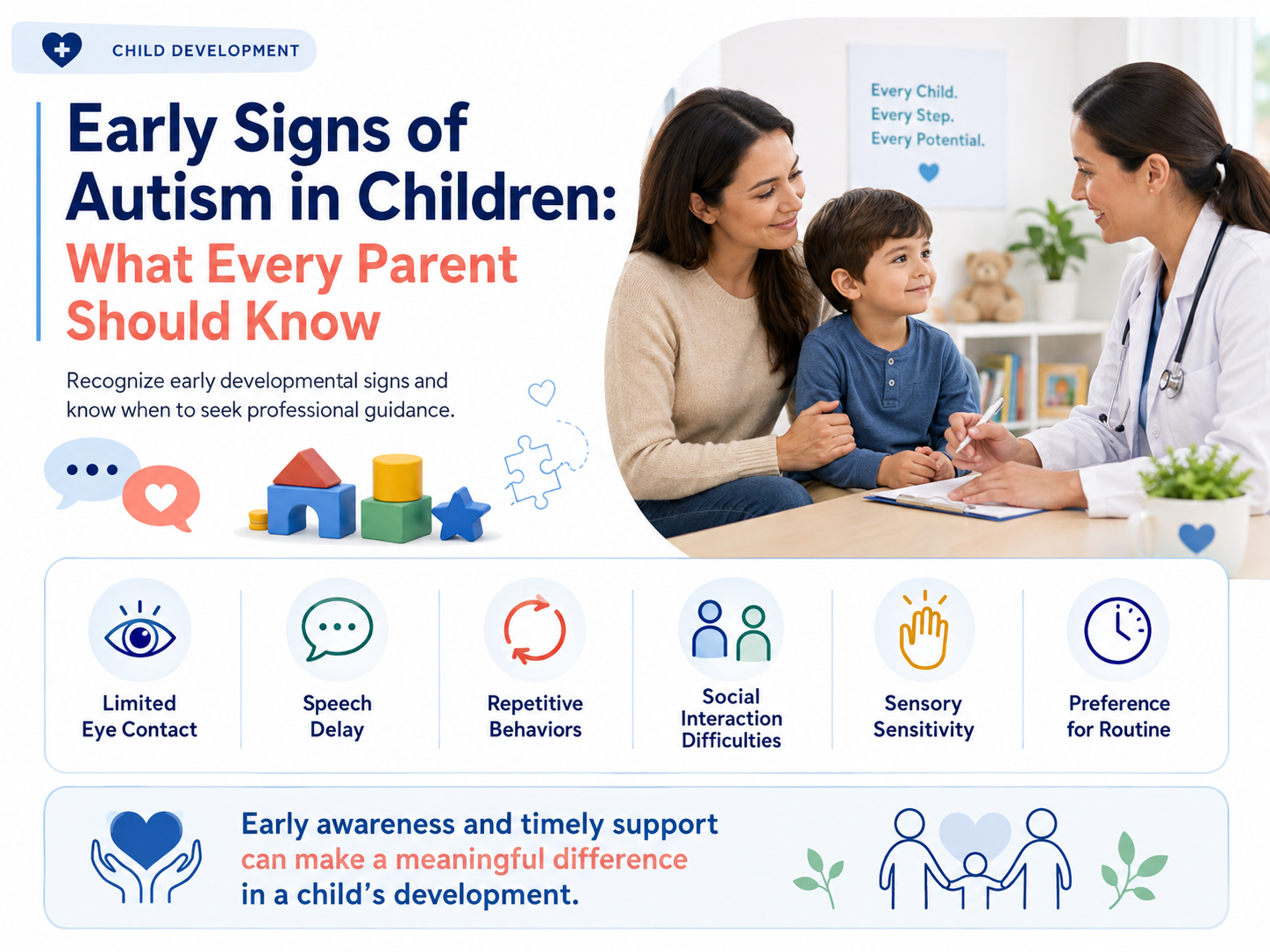
As a developmental pediatrician, I meet many parents who sensed, quietly and early, that their child was developing a little differently — but weren’t sure whether to act or simply wait. If that’s you, I want to reassure you of two things: first, you know your child better than anyone, and trusting your instincts is exactly the right thing to do; and second, recognising the early signs of autism is not about labelling your child, but about understanding them so you can give them the support they need to thrive. In this guide, I’ll explain the early signs of autism, what they do and don’t mean, and when it’s worth seeking an assessment.
What is autism spectrum disorder?
Autism Spectrum Disorder (ASD) is a neurodevelopmental difference — a different way in which a child’s brain is wired to communicate, interact socially, and experience the world. It’s called a spectrum because it looks different in every child: some need a great deal of support, while others need very little. I strongly believe in neurodiversity — autism is not a disease to be cured, but a different way of being, and autistic children have their own unique strengths. Our role is to understand each child and help them flourish as who they are.
Early signs of autism by age
Every child grows at their own pace, so these are gentle guides, not strict rules. Still, certain milestones are worth watching:
- By 6 months: limited big, warm smiles or joyful expressions; little eye contact
- By 9 months: limited back-and-forth sharing of sounds, smiles, or facial expressions
- By 12 months: not responding to their name; little or no babbling; not using gestures like pointing or waving
- By 16 months: no spoken words
- By 24 months: no meaningful two-word phrases (not just repeating)
- At any age: loss of speech, babbling, or social skills that were previously present
Common early signs to look for
Beyond milestones, autism often shows in a few key areas:
Social communication. Reduced eye contact; not responding to their name; limited joint attention (not pointing to share interest, or not following when you point); few social smiles; and limited back-and-forth play like peek-a-boo.
Language. Delayed speech, or repeating words and phrases without using them meaningfully (echolalia); sometimes an unusual tone or rhythm of voice.
Behaviour and interests. Repetitive movements such as hand-flapping, rocking, or spinning; lining up toys; intense focus on parts of objects; a strong need for sameness and routine, with distress at small changes.
Sensory responses. Unusually strong or muted reactions to sounds, textures, lights, tastes, or smells.
Play. Limited pretend or imaginative play, and a preference for playing alone.
A word about regression
In a minority of children, autism first appears as a loss of skills — a toddler who was babbling, pointing, or using a few words between 15 and 24 months suddenly stops. This can be very frightening for parents. If you notice your child losing skills they once had, please don’t wait — it deserves prompt evaluation.
Showing some signs doesn’t mean your child is autistic
This is important. Many typically developing toddlers show one or two of these signs from time to time — it’s completely normal. Noticing a few does not mean your child has autism. What it does mean is that an evaluation is worthwhile, simply to understand your child’s development clearly. What I gently ask parents to avoid is the “wait and see” approach when there are genuine concerns, because time is precious in these early years.
What causes autism?
Let me address the questions that weigh heavily on so many parents. Autism is a neurodevelopmental condition with strong genetic links — it is not caused by anything you did as a parent, and it is not caused by vaccines. This myth has been thoroughly disproven by extensive research. Please set aside any guilt: nothing in your parenting caused your child’s autism, and understanding this frees you to focus your energy where it truly helps — on support.
How is autism diagnosed?
There is no single blood test for autism. As a developmental pediatrician, I make a diagnosis through careful observation and a detailed developmental assessment, often using validated tools (such as the M-CHAT screening questionnaire and structured observation). I also check your child’s hearing — including tests like BERA and OAE, available at our clinic — because hearing difficulties can sometimes look like autism or occur alongside it. The goal is a clear, compassionate understanding of your child’s unique profile.
Why early identification matters
The young brain is remarkably adaptable, which is why early support makes such a meaningful difference. Therapies like ABA, speech therapy, and occupational therapy — tailored to your child — can strengthen communication, social skills, and independence, building on your child’s natural strengths. I want to be clear that this is not about “fixing” your child, but about giving them the tools to thrive. And if your child is a little older, please don’t lose heart — it is never too late to help, and support is valuable at every age.
Supporting your child at Dr. Priti Mhatre’s Clinic
If you have concerns about your child’s development, I’m here to help you understand them with clarity and compassion — never judgement. At my clinic, with over 15 years of experience supporting 5,000+ families, I provide gentle, accurate autism assessments and personalised, family-centred care across Navi Mumbai and Thane.